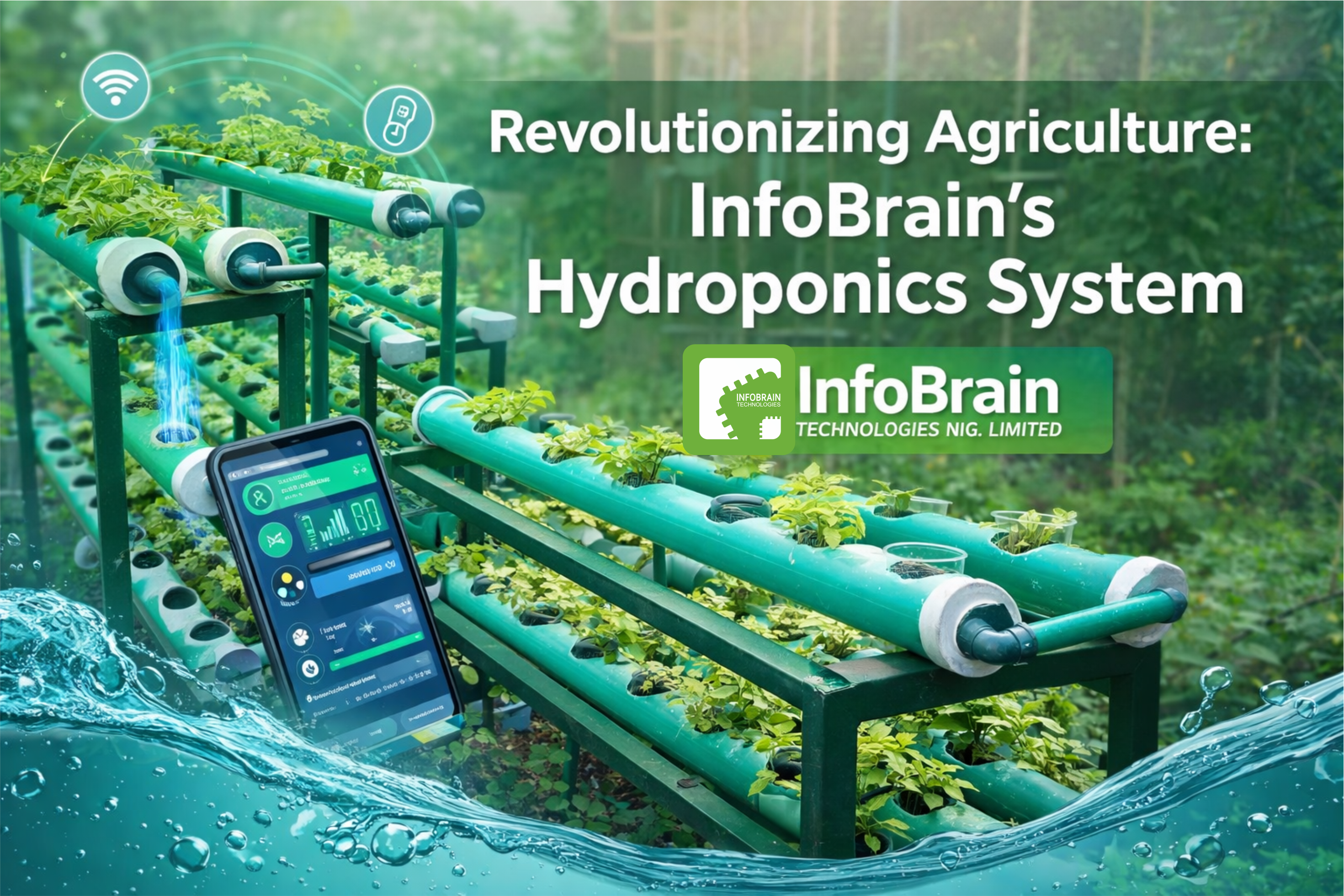
REVOLUTIONIZING SMART AGRICULTURE: INFOBRAIN’S IOT-ENABLED HYDROPONICS RESEARCH PROJECT AT LASUSTECH
At InfoBrain Technologies Nig. Ltd, innovation is not just a concept, it is a continuous research-driven commitment to solving real-world challenges. One of our landmark research projects was the design and construction of an IoT-Enabled Hydroponics Farming System developed for the Agricultural Department at Lagos State University of Science and Technology (LASUSTECH) during the year 2022.
This project was not just a construction of a hydroponic farm, it was a research-driven initiative aimed at demonstrating how smart technology, automation, and data intelligence can transform agricultural productivity in Nigeria and beyond.

Early stage construction of the hydroponics system.

Control Box of the Hydroponic System
Project Background
The Agricultural Department at LASUSTECH required a functional, research-grade hydroponics system that would:
-
Support academic research and experimentation
-
Enable students to study soilless farming techniques
-
Demonstrate sustainable agricultural practices
-
Serve as a prototype for smart farming systems
InfoBrain Technologies was engaged to conceptualize, design, and construct a durable, efficient, and expandable hydroponic structure suitable for institutional research and practical demonstrations.
System Design & Engineering
The hydroponics system constructed by InfoBrain features a multi-layered pipe-based nutrient film technique (NFT) structure designed for optimal water circulation and plant growth efficiency.
Key Engineering Components:
-
PVC Channel Growth System: Structured horizontal pipes designed for steady nutrient flow.
-
Recirculating Nutrient Reservoir: Minimizes water waste through controlled recycling.
-
Electric Pump & Flow Regulation System: Ensures consistent nutrient distribution across all plant channels.
-
Support Frame Fabrication: Durable metal framework engineered for structural stability and longevity.
-
Modular Expansion Design: Allows scalability for larger research or commercial deployment.
The entire system was carefully calibrated to support controlled nutrient flow, oxygenation, and root development, essential elements for effective hydroponic cultivation.
IoT-Based Monitoring and Control
What sets this project apart is its IoT-enabled remote management system.
InfoBrain developed a custom web interface that allows authorized users to:
-
Monitor water levels
-
Control nutrient flow
-
Regulate water pumps
-
Track system performance
-
Access system data remotely
Through sensors and microcontroller integration, the hydroponics system transmits real-time data to a centralized web dashboard. This enables agricultural researchers and students at LASUSTECH to observe, analyze, and adjust system parameters from anywhere.
This approach bridges the gap between agriculture and digital technology.
Research & Academic Value
This project was not merely about building a hydroponic farm, it was about creating a research platform.
The system enables:
-
Controlled experimentation on nutrient formulations
-
Comparative crop yield analysis
-
Water efficiency studies
-
Climate-controlled growth observations
-
Research into urban and vertical farming systems
By eliminating soil dependency, the system allows students and researchers to focus on plant physiology, nutrient science, and precision agriculture technologies.
Innovation Impact
1. Water Efficiency: Hydroponics systems can use significantly less water compared to traditional soil farming due to recirculation and controlled delivery.
2. Urban Agriculture Possibility: The modular design demonstrates the potential for rooftop, greenhouse, and urban farming integration — highly relevant for densely populated cities like Lagos.
3. Climate Adaptability: The system can be integrated with greenhouse automation, IoT monitoring, and AI-driven nutrient management systems.
4. Food Security Enhancement: By promoting high-yield, space-efficient farming, the system contributes to long-term food sustainability solutions.
5. Academic Advancement: The system provides hands-on exposure to agricultural technology, automation, and digital innovation for LASUSTECH students.
Technical Challenges & Research Insights
During development, InfoBrain’s research team focused on:
-
Achieving balanced nutrient flow distribution
-
Preventing root clogging within pipe channels
-
Ensuring structural durability under environmental exposure
-
Designing a cost-effective yet research-grade system
Through rigorous testing and calibration, the team successfully optimized system stability, nutrient circulation, and long-term performance reliability.
Demonstrating InfoBrain’s Capability
This project reflects InfoBrain’s broader strengths in:
-
Research and prototyping
-
Engineering design and fabrication
-
Automation system integration
-
Sustainable technology development
-
Academic collaboration and institutional projects
Our ability to conceptualize, design, and deliver a functional hydroponic research system for a tertiary institution reinforces our position as an innovation-driven technology company.
Future Possibilities
The LASUSTECH Hydroponics Project opens doors to:
Automated nutrient optimization using machine learning
-
Large-scale commercial smart farms
-
Smart greenhouse integration
-
Solar-powered agricultural systems
-
Commercial hydroponic farm deployment
-
Agricultural startup incubation partnerships
InfoBrain Technologies Nig. Ltd is positioned to scale this solution from academic research environments to commercial agricultural ecosystems.
Conclusion
The Hydroponics Research System developed for LASUSTECH is a practical demonstration of InfoBrain’s innovation capacity, research excellence, and engineering capability.
It represents more than a farming prototype, it is a forward-looking agricultural solution built on technology, sustainability, and scalability.
As we continue to explore the intersection of engineering and agriculture, InfoBrain remains committed to developing research-backed innovations that drive progress, empower institutions, and contribute meaningfully to national development.
At InfoBrain, research is not theoretical, it is applied, impactful, and transformative.