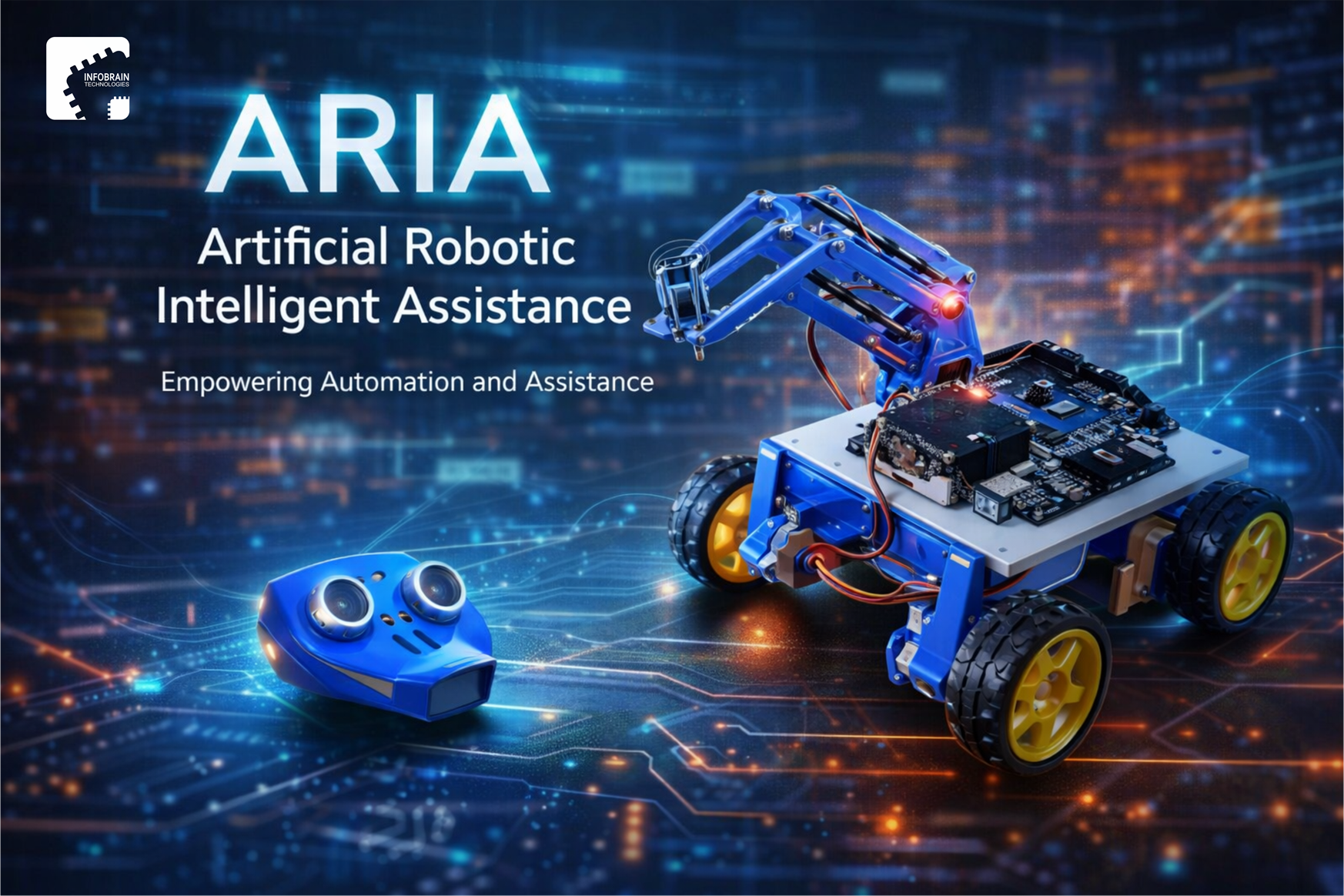
INTRODUCING ARIA: ARTIFICIAL ROBOTIC INTELLIGENT ASSISTANCE
In pursuit of advancing intelligent automation and human-robot collaboration, InfoBrain Technologies Nig. Ltd. initiated and funded the development of ARIA — Artificial Robotic Intelligent Assistance.
ARIA is a research-driven robotic system designed to assist individuals in performing simple physical tasks while serving as a foundation for deeper artificial intelligence integration in the future.
This project represents InfoBrain’s commitment to building practical robotics solutions tailored to real-world environments.
Project Vision
The long-term goal of ARIA is to develop an intelligent robotic assistant capable of interacting naturally with humans, understanding commands, and executing tasks autonomously.
As part of this vision, ARIA is being designed to integrate with Brainiac, InfoBrain’s proprietary Artificial Intelligence system, enabling:
-
Natural language communication
-
Intelligent decision-making
-
Context-based response
-
Continuous learning capabilities
ARIA is not just a robotic arm — it is the beginning of a human-centered intelligent robotic ecosystem.

Early construction of ARIA, Initially known as Pinky Drop
Core Capabilities of ARIA (Current Development Stage)
1. Autonomous Mobility
ARIA is built on a mobile robotic platform that allows it to move around a defined premises. This mobility enables it to operate beyond a fixed station, making it adaptable for homes, offices, laboratories, and industrial environments.
2. Object Identification
Using integrated sensors and camera-based recognition systems, ARIA can identify objects within its environment. This enables intelligent interaction rather than blind mechanical motion.
3. Pick and Place Functionality
At the core of ARIA is a robotic arm engineered for precision handling. The system can:
-
Grip objects
-
Lift items
-
Relocate materials
-
Perform controlled placement
This makes it useful for assistance tasks such as organizing items, transferring objects, or supporting light-duty activities.
4. Remote Control Operation
ARIA can be remotely controlled, allowing users to:
-
Navigate the robot
-
Operate the robotic arm
-
Execute task commands
This feature enhances safety, flexibility, and ease of use in different environments.
5. Data Storage and System Logging
The system is capable of storing operational data, enabling performance tracking and further research optimization. This functionality supports future AI training and behavioral improvements.
6. Voice Command Recognition
ARIA currently understands simple voice commands, allowing users to initiate basic instructions without manual controls. This feature is foundational for future advanced conversational AI integration through Brainiac.
Research Significance
ARIA is a strategic research investment fully funded by InfoBrain Technologies Nig. Ltd.
The project demonstrates the company’s ability to:
-
Design and fabricate robotic hardware
-
Integrate embedded systems and microcontrollers
-
Develop motion control mechanisms
-
Implement sensor fusion systems
-
Engineer AI-ready robotic platforms
It also serves as a practical research base for:
-
Human-Robot Interaction (HRI)
-
Autonomous robotics
-
Intelligent automation systems
-
AI-integrated mechanical systems
Future Roadmap: Brainiac Integration
The next evolution of ARIA involves deeper integration with Brainiac, InfoBrain’s Artificial Intelligence engine.
Future enhancements will focus on:
-
Conversational interaction
-
Adaptive task learning
-
Intelligent environment mapping
-
Decision-based autonomy
-
Cloud-based data synchronization
-
AI-powered behavioral modeling
With Brainiac integration, ARIA will evolve from a programmable robotic assistant into an intelligent companion capable of contextual understanding and adaptive support.
Potential Applications
ARIA has scalable potential across multiple sectors:
-
Assisted living support
-
Laboratory automation
-
Educational robotics platforms
-
Light industrial automation
-
Smart home assistance
-
Research laboratories
As development progresses, ARIA could serve as a foundational robotics solution adaptable to diverse industries.
Innovation at the Core
ARIA reflects InfoBrain’s multidisciplinary strength in:
-
Robotics Engineering
-
Artificial Intelligence Development
-
Embedded Systems
-
Mechanical Design
-
IoT Integration
-
Applied Research & Prototyping
This project underscores InfoBrain’s ability to conceptualize, design, build, and iterate intelligent systems from the ground up.
Conclusion
ARIA (Artificial Robotic Intelligent Assistance) is more than a robotic arm — it is a research milestone demonstrating InfoBrain’s capacity to engineer intelligent, scalable, and AI-integrated robotic systems.
As Brainiac integration advances, ARIA moves closer to becoming a fully interactive intelligent robotic assistant, reinforcing InfoBrain Technologies Nig. Ltd.’s mission to build transformative technologies that redefine automation and human-machine collaboration.