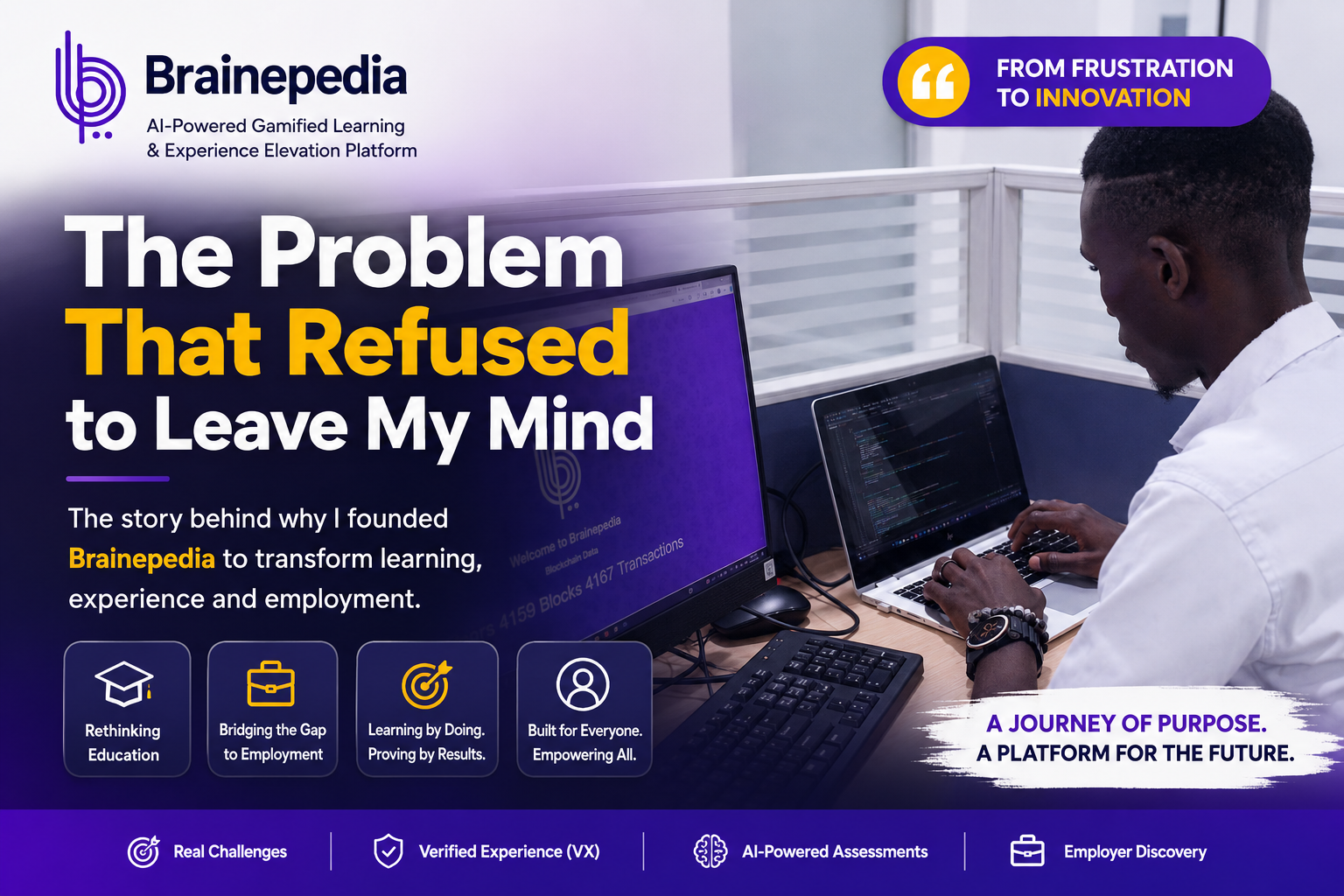
THE PROBLEM THAT REFUSED TO LEAVE MY MIND
There was a question that kept bothering me for years:
Why do we spend over 20 years in school, yet many graduates still struggle to prove they can solve real-world problems?
I watched brilliant students graduate with First Class degrees only to spend years searching for jobs.
I watched employers reject capable people simply because they didn't have "3–5 years of experience."
I watched talented individuals leave school to learn practical skills and trades, and in many cases, build more successful careers than people with outstanding academic records.
I watched parents invest millions of naira—from nursery school through university—hoping education would secure a better future for their children. Yet many graduates spend years trying to recover even a fraction of that investment because the transition from classroom to career is so difficult.
Then I asked myself another question:
What if we stopped measuring people by what they claim to know and started measuring them by what they can actually do?
That question became an obsession.
My Turning Point
I had noticed the cracks in the education system as far back as my secondary school days and during my OND programme.
But everything became crystal clear when I returned to LASPOTECH (now Lagos State University of Science and Technology) for my HND.
For almost the entire two-year programme, I hardly attended lectures or visited the school except for tests and examinations. I was working full-time as a teacher while studying independently using only the departmental syllabus.
Despite that unconventional approach, I graduated as one of the best students in my department.
That experience challenged my assumptions about learning. It wasn't that education lacked value—it was that the way knowledge was delivered and measured often didn't reflect the realities of modern work.
It made me ask:
Why should learning move slower than the industries it is meant to serve?
Technology changes every few months.
Industries evolve continuously.
Job requirements shift faster than university curricula.
Yet graduates are still expected to spend another three to six years "gaining experience" before being considered ready.
There had to be a better way.
The Birth of Brainepedia
In 2022, I decided to stop asking questions and start building solutions.
The journey began with just a few lines of code.
Before Brainepedia, there was Brain Tech Academy.
Then came Code Arena.
Each iteration taught valuable lessons and brought us closer to a bigger vision.
Eventually, everything evolved into what is now Brainepedia—an AI-powered gamified learning and experience elevation platform designed to bridge the gap between learning, competence, and employment.
Brainepedia is built on one simple belief:
Competence should be proven, not assumed.
Instead of relying only on certificates, CVs, or years of experience, professionals should have the opportunity to demonstrate what they can actually do through real-world missions, AI-powered assessments, Verified Experience (VX), and measurable performance.
Why Brainepedia Matters
We believe learning should be:
- Practical, not just theoretical.
- Accessible, regardless of financial background.
- Measurable through real performance.
- Directly connected to career opportunities.
Brainepedia is designed for everyone:
- Students preparing for the future.
- Professionals looking to grow.
- Career changers.
- Employers searching for proven talent.
- Organizations developing stronger teams.
Our vision is bold:
Imagine a 13-year-old with curiosity, consistency, and determination becoming highly competent in a professional field long before traditional career timelines would suggest. Not by skipping the hard work, but by solving meaningful challenges, building practical skills, and proving competence through real achievement.
We want to make quality, practical learning more accessible and create clearer pathways between learning and employment.
This Is Only the Beginning
There is still so much to build.
So many professions to onboard.
So many missions to create.
So many industries to transform.
This journey has never been about software alone.
It is about changing how the world discovers talent.
It is about making competence visible.
It is about giving people opportunities based on what they can do—not just what is written on paper.
Thank You
Brainepedia would not exist without an incredible community of people.
To every developer who wrote a line of code.
To every designer who improved a screen.
To every tester who found a bug.
To every person who challenged an idea, offered feedback, or believed in the vision.
Thank you.
Every contribution—big or small—helped shape what Brainepedia is becoming.
To the entire Brainepedia Team, thank you for your commitment, resilience, and belief in this mission.
We are only getting started.
The future belongs to those who can prove what they know.
And we're building the platform that makes that possible.